
Scenario
Day trading systems exit before the close, missing the substantial overnight edge that exists in equity indices. But holding positions overnight introduces gap risk and drawdown exposure that many traders want to avoid. Swing systems bridge this gap: they hold for multiple days when momentum is strong (capturing the overnight drift premium) while using generous profit targets and stops sized for the bigger moves. The challenge is optimizing for longer hold times without curve-fitting to a few exceptional winning days. This methodology uses specialized fitness functions that reward consistent average trade size while filtering for profit factor—avoiding the common trap of systems that show huge profits from one or two outlier trades.
Approach
Set up parameters for multi-day holds:
• Entry type: Compare2 (not AnyIndicatorCross)
• Secondary filter: CloseLessPrevCloseDBPV (NOT normalized)
• Data: 30-minute ES bars from 1997 onward
• Direction: Long only
• Stop loss: $4,000
• Profit target: $2,750
• Wider stops account for overnight gaps and multi-day moves
• Micro contracts: use 1/10th these values
Test against proven performance:
• Load included benchmark (built June 2018)
• System uses 1 tick slippage and $2.40/side commission
• Live-traded successfully despite sub-optimal build settings
• Excellent OOS results prove robust edges overcome imperfect config
• Use this as baseline for comparison
But build your new systems with current best practices.
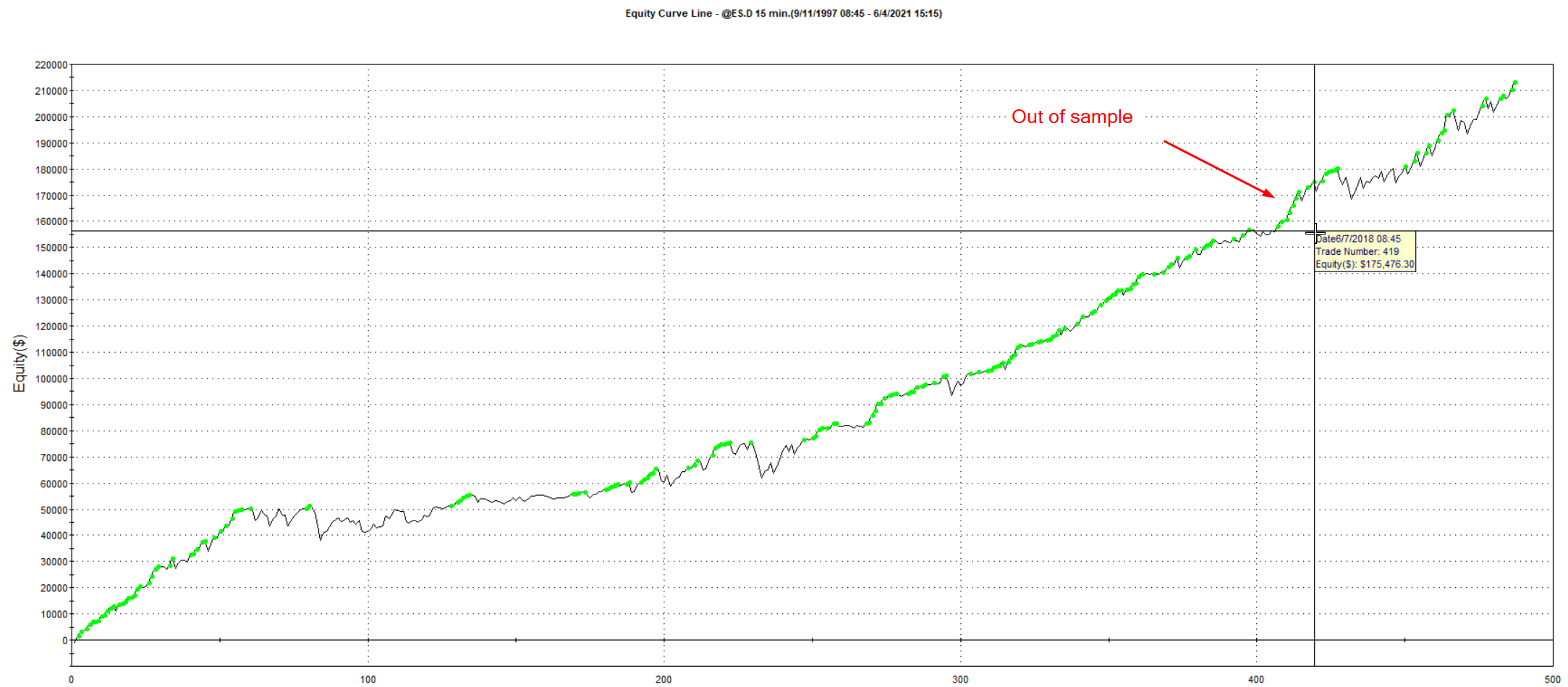
June 2018 system showing consistent out-of-sample performance through 2021
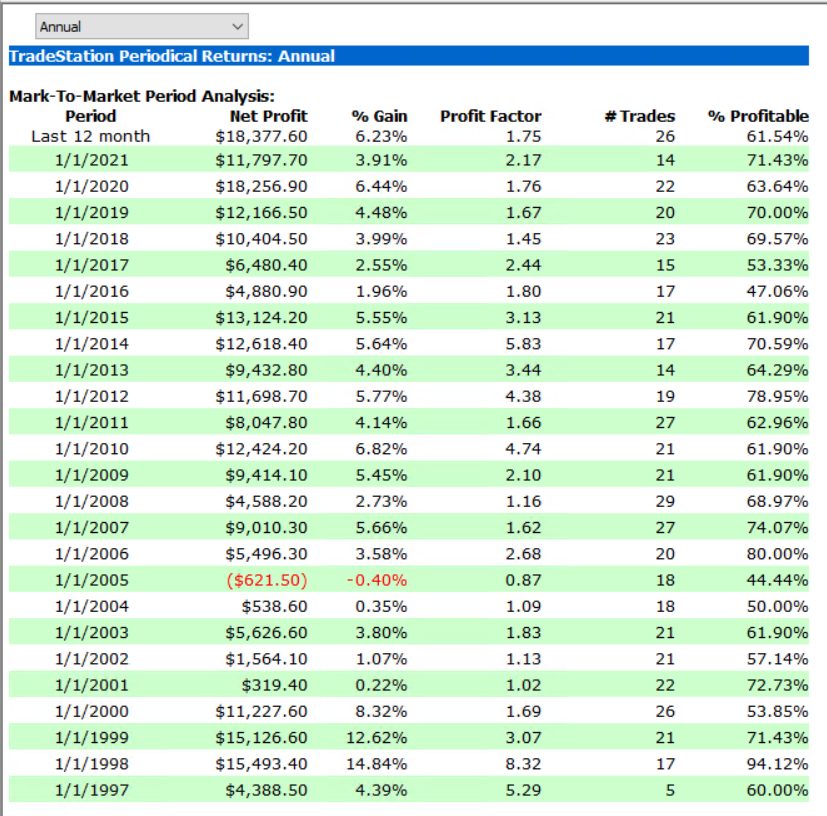
Performance metrics including 1 tick slippage and $2.40/side commission
Choose fitness that matches your goals:
• Option 1: NetProfit × PFLateEntry × AverageTrade (default)
• Option 2: NetProfitPercentProfitableRatioAveWinAveLess
• Fitness choice dramatically impacts system selection
• Alternative fitness may produce fewer trades but high consistency
• Test both functions
• Compare walk-forward results
Different fitness = different system characteristics.
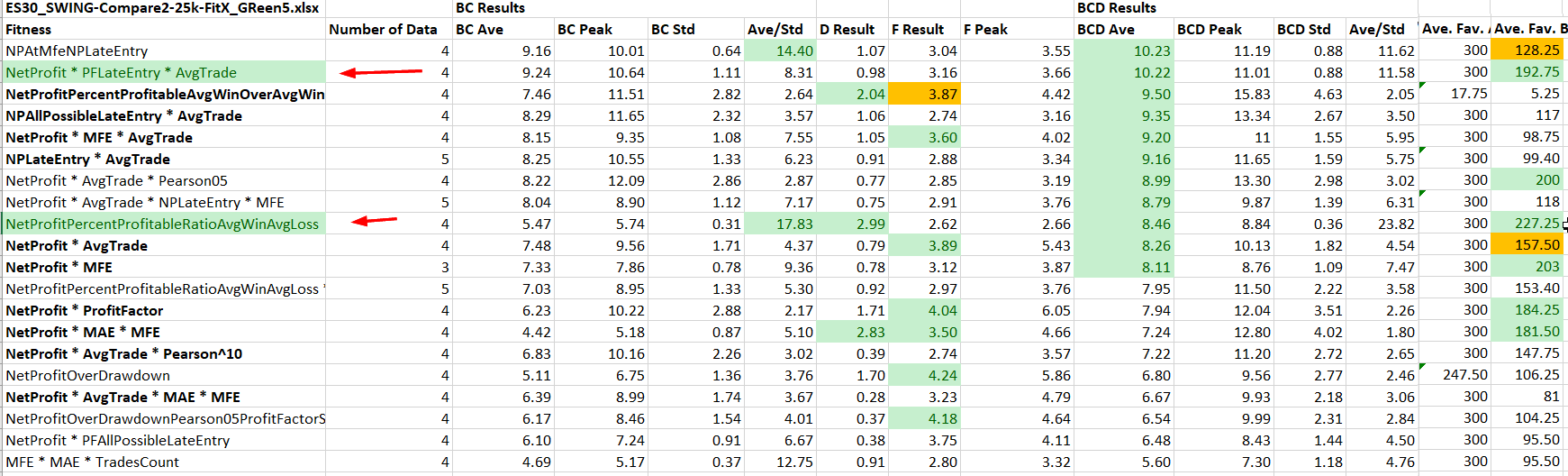
Two fitness options: default vs. NetProfitPercentProfitableRatioAveWinAveLess
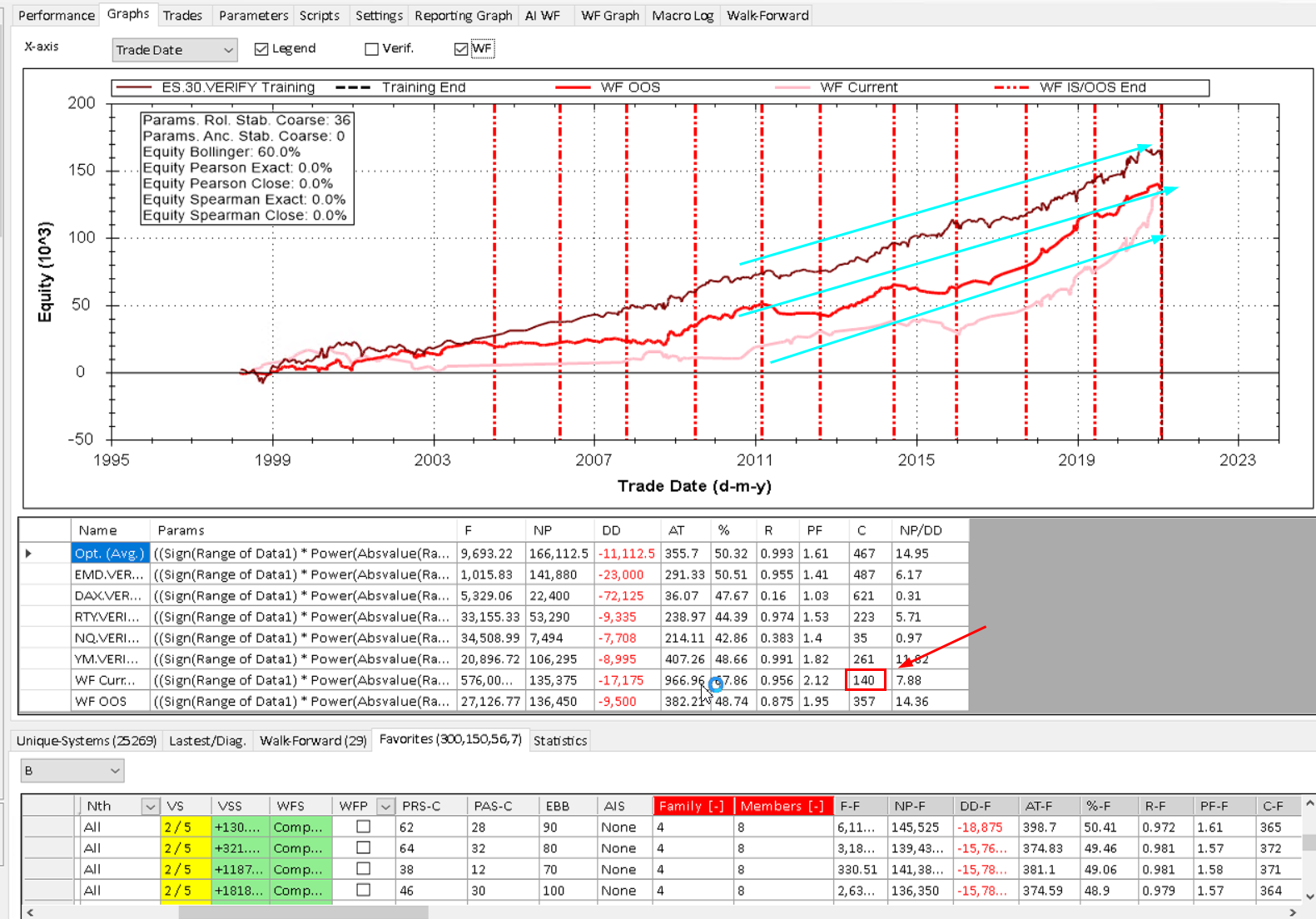
System chosen for parallel walk-forward curves and strong family member results
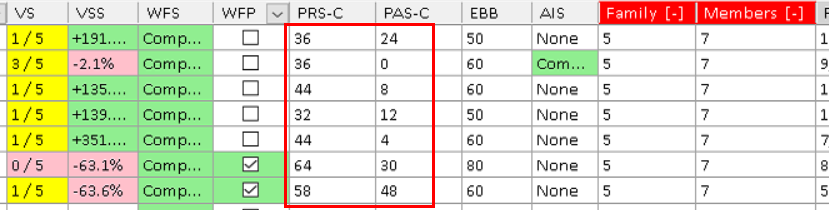
Rolling WF stability fair, anchored stability lower but overall results strong
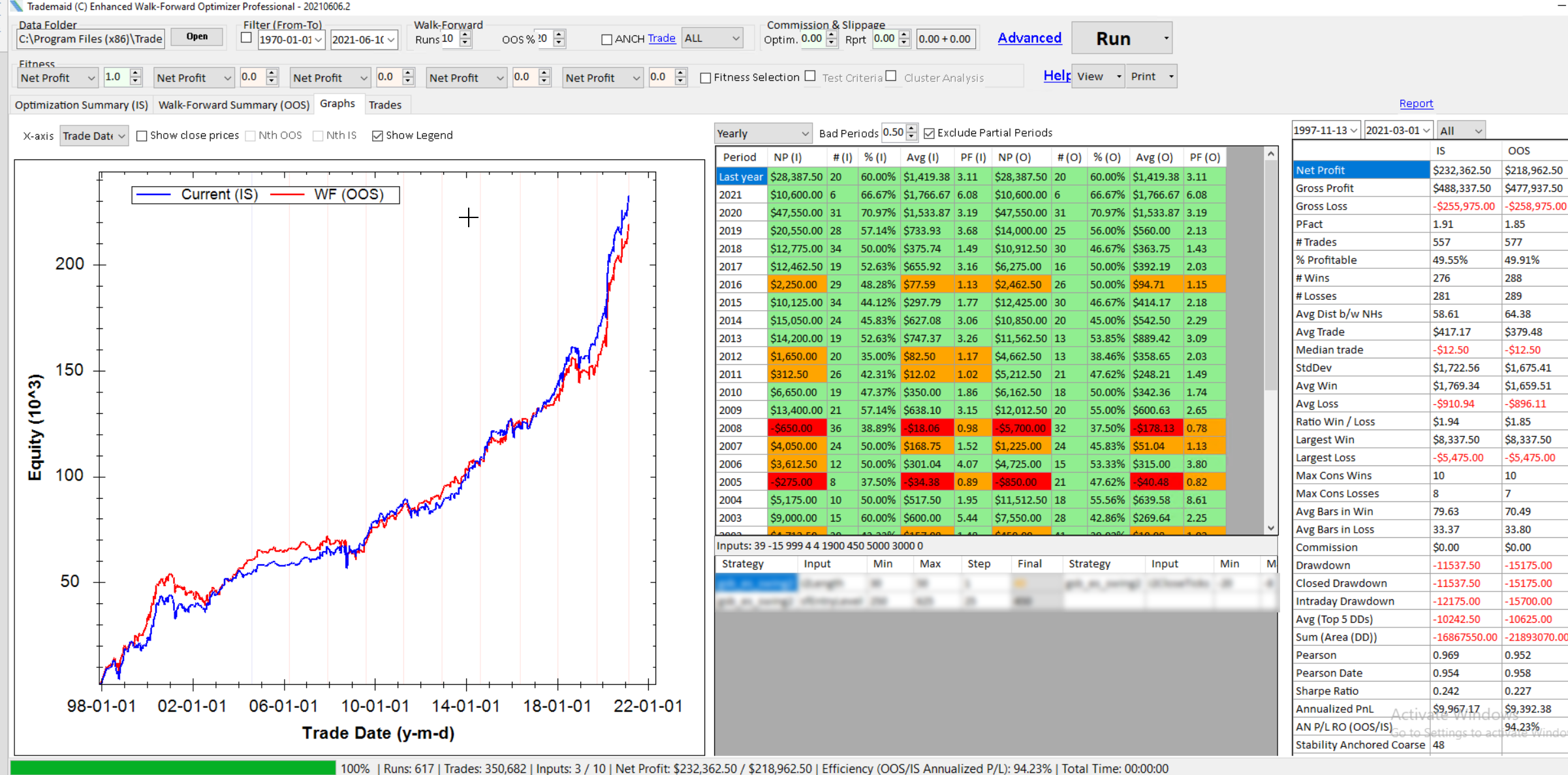
Rolling WF $218,962 exceeding anchored $206,962—rare and positive signal
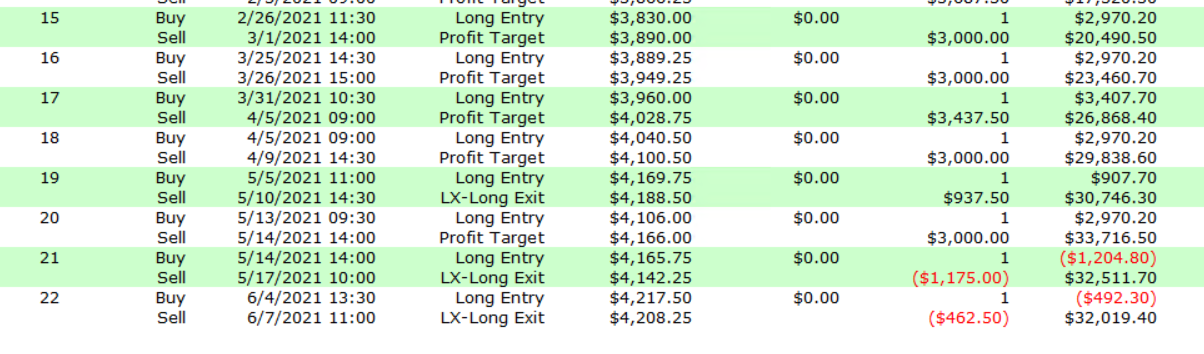
New system vs. legacy benchmark on completely unseen data (post Feb 26, 2021)
Test on related markets for confidence:
• Run systems on YM (Dow)
• Test on EMD (Dax)
• Try on NQ (Nasdaq)
• Systems profitable across multiple indices = capturing broad behavior
• Not market-specific noise
• Featured system showed good results on EMD and YM
This uncommon step confirms genuine edges.
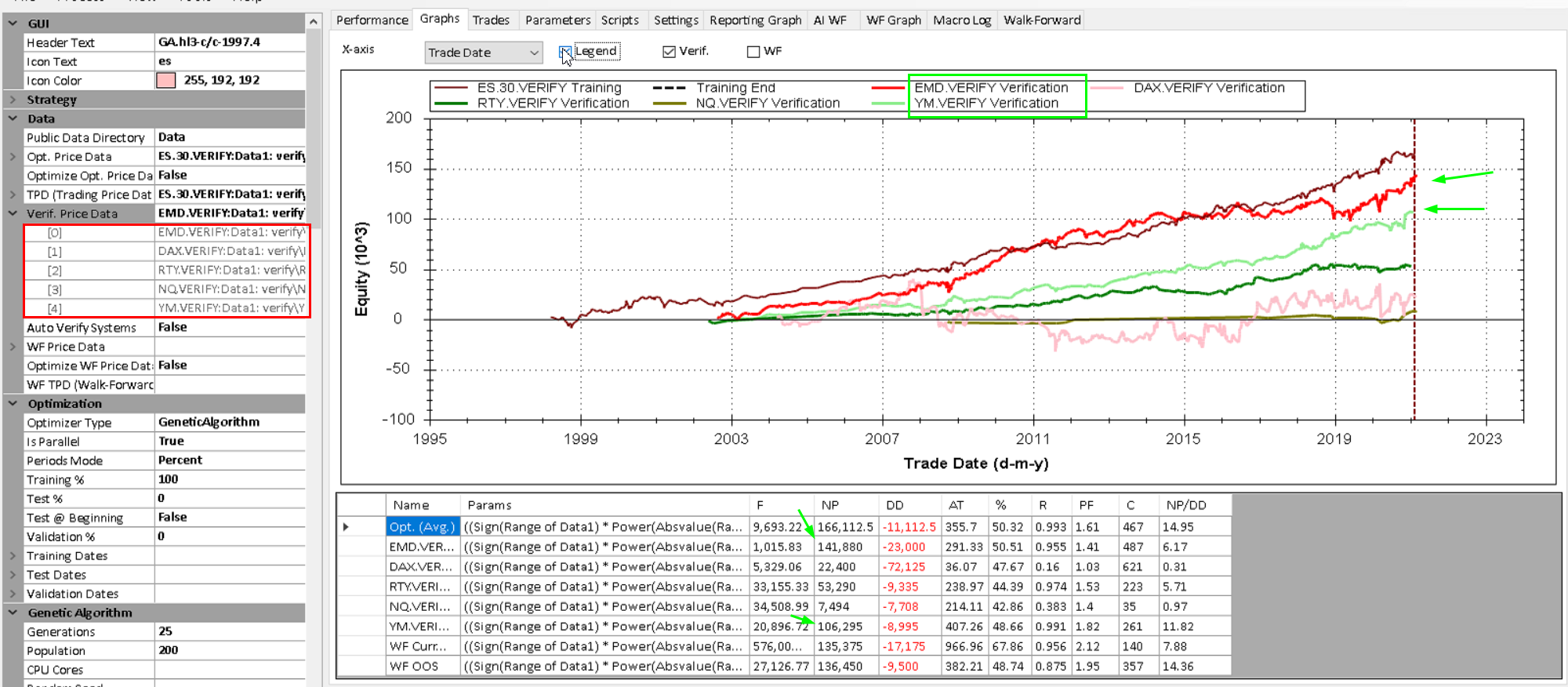
System validation showing good performance on Dow (YM) and Dax (EMD) futures
For ultimate refinement (time-intensive):
• Use EWFO in TradeStation
• Manually optimize each indicator weight
• Test each parameter individually
• Discover non-obvious sweet spots
• Example finding: weight=1000 works best
• Converts indicator to sign function (-100, 0, +100 only)
• Genetic builds never find these insights
Requires substantial time but reveals hidden optimizations.
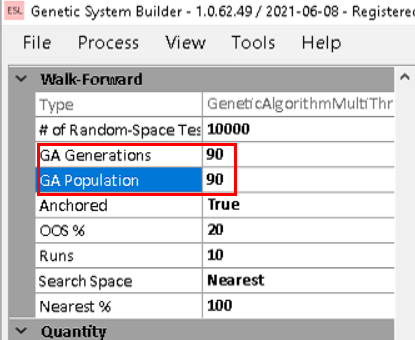
Alternative entry type (Compare3) showing 90,90 iterations instead of 130,130
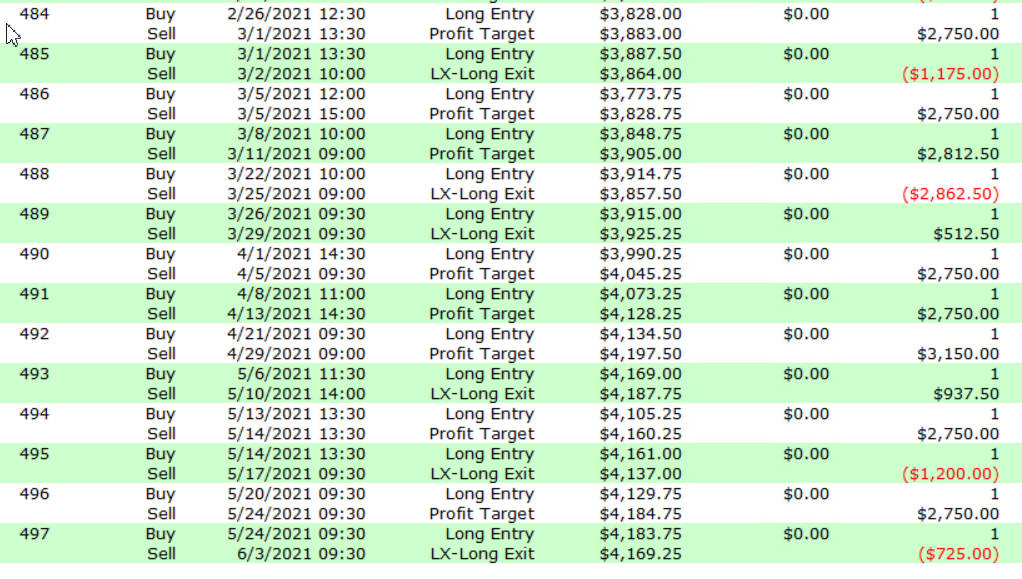
Feb 26, 2021 forward results with $4.80 brokerage and 2 ticks slippage
Results & Insights
Swing systems produced remarkably strong results: anchored walk-forward showed $206,962, while rolling walk-forward (a harsher test with less optimization data per period) showed $218,962. This rare scenario where rolling outperforms anchored suggests the system captures genuine market structure rather than curve-fitting specific regimes. Out-of-sample results (all data after February 26, 2021) maintained profitability with realistic slippage and commissions. The approach produced nice parallel walk-forward curves with good stability scores, though not the highest possible—systems were selected based on good OOS results and parallel curves rather than chasing maximum stability metrics. The diversity of possible systems (combining this swing approach with existing day trading, overnight, and Vegas-style systems) provides substantial portfolio diversification opportunities.
Key Takeaways
Swing systems with $4,000 stops capture bigger moves than day trading systems with $500-$1,250 stops
Long-only approaches work remarkably well on equity indices due to the persistent upward drift
Compare2 entry outperforms crossover entries for swing systems (opposite of day trading findings)
Fitness function selection dramatically impacts system characteristics—test multiple options
Cross-market validation (testing on YM, NQ, EMD) builds confidence in robustness
Manual optimization of key parameters can reveal insights (like weight=1000) that genetic builds miss
Based on methodology examples from Building S&P 500 Swing Systems documentation, used with permission.