
Crude Oil Day-of-Week Strategy: Trading Wednesday-Only Systems
Discover how isolating a single day of the week (Wednesday) can produce robust crude oil systems by exploiting consistent weekly news cycles and market behavior patterns unique to energy markets.
Scenario
Many markets exhibit strong day-of-week biases driven by recurring news announcements and institutional trading patterns. In crude oil, weekly inventory reports and geopolitical developments create predictable volatility windows. Traditional approaches trade all five weekdays, diluting the edge from the strongest day with noise from weaker days. This methodology tests each weekday independently, then builds systems exclusively on the best-performing day. The challenge: reducing the sample size to 20% of a full-week system means you need substantially more historical data to achieve statistical significance—ideally 300+ trades to build robust parameters.
Approach
Set up specialized crude oil trading parameters:
• Use 15-minute bars with exchange time data
• Data range: 9:00 AM to 2:30 PM
• Trading window: 10:00 AM to 2:30 PM only
• Skip first hour to avoid volatile, unreliable price action
• Secondary filter: CloseLessPrevLowDPrevCloseD (normalized)
• Entry mode: Compare2
• Indicator set: trial-version indicators (68 total)
First pass - Cast a wide net:
• Build 50,000 systems with GreenMax10 macro
• Use all available indicators
• Select indicators appearing in green AND orange
• Keep borderline performers to maintain sample size
Second pass - Keep only winners:
• Rebuild 50,000 systems with filtered set
• This time select ONLY green indicators
• Typically narrows down to 7-10 proven indicators
This prevents discarding valuable indicators too early.
Discover which weekday has the strongest edge:
• Build systems allowing all weekdays (Monday-Friday)
• Allow both long and short positions
• Export ~168 systems to Portfolio Analyst Pro
• Analyze daily performance breakdowns
• Critical: keep OOS boundary before Feb 28, 2018
• This prevents data mining the day-of-week bias itself
Results typically show Wednesday strongest, Friday weakest.
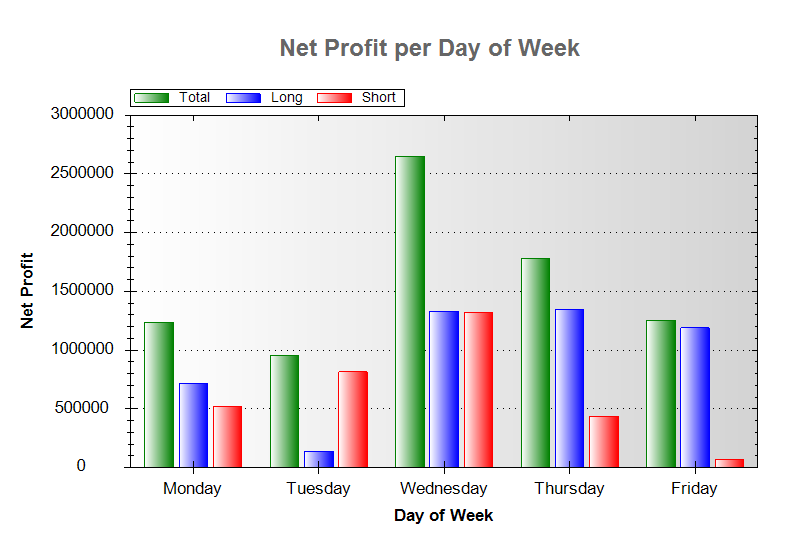
Day-of-week analysis showing Wednesday (Wed) dominance and Friday (Fri) weakness
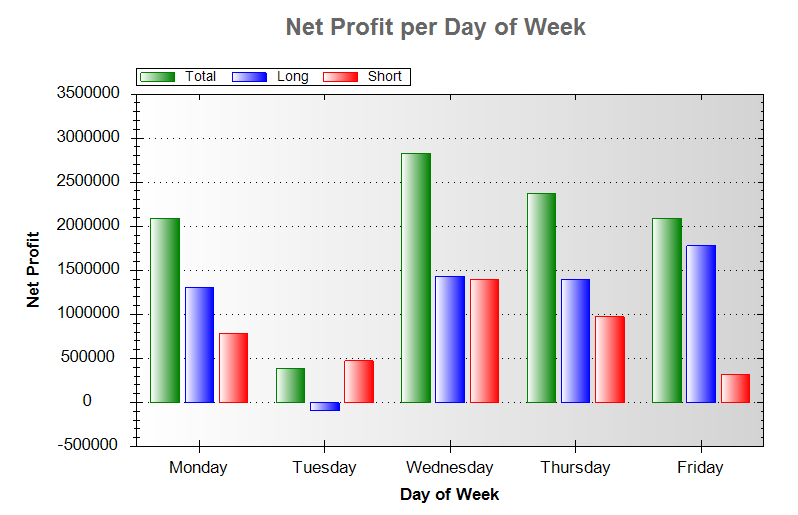
Second test confirming Wednesday strength across different system parameters
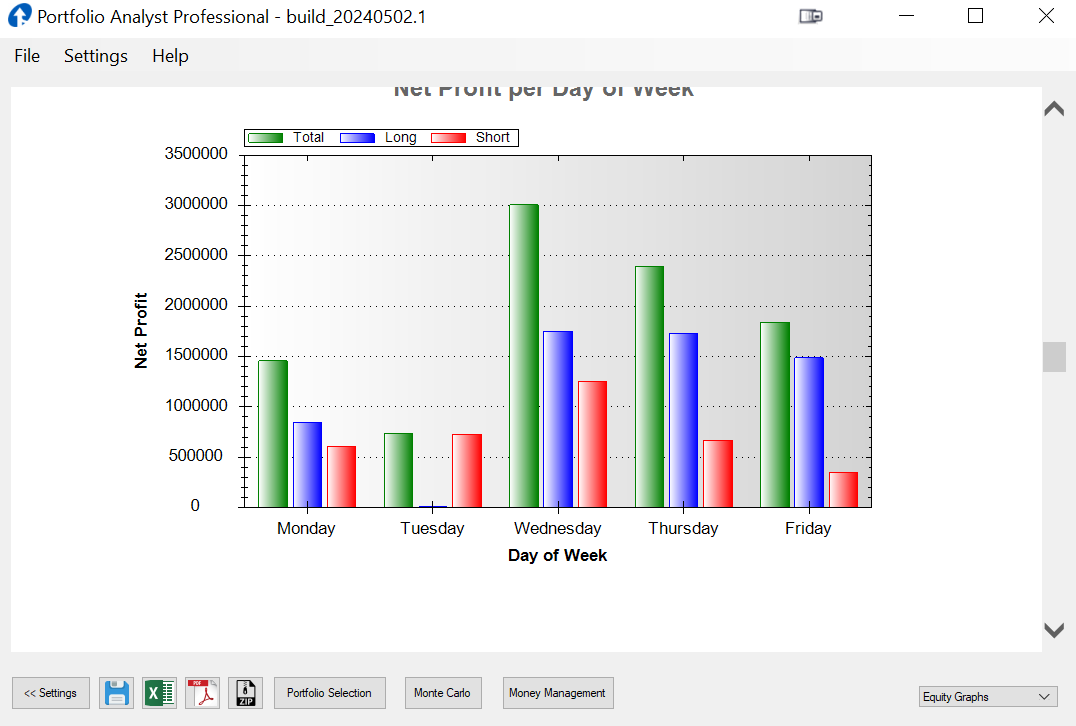
Third validation run showing consistent day-of-week patterns
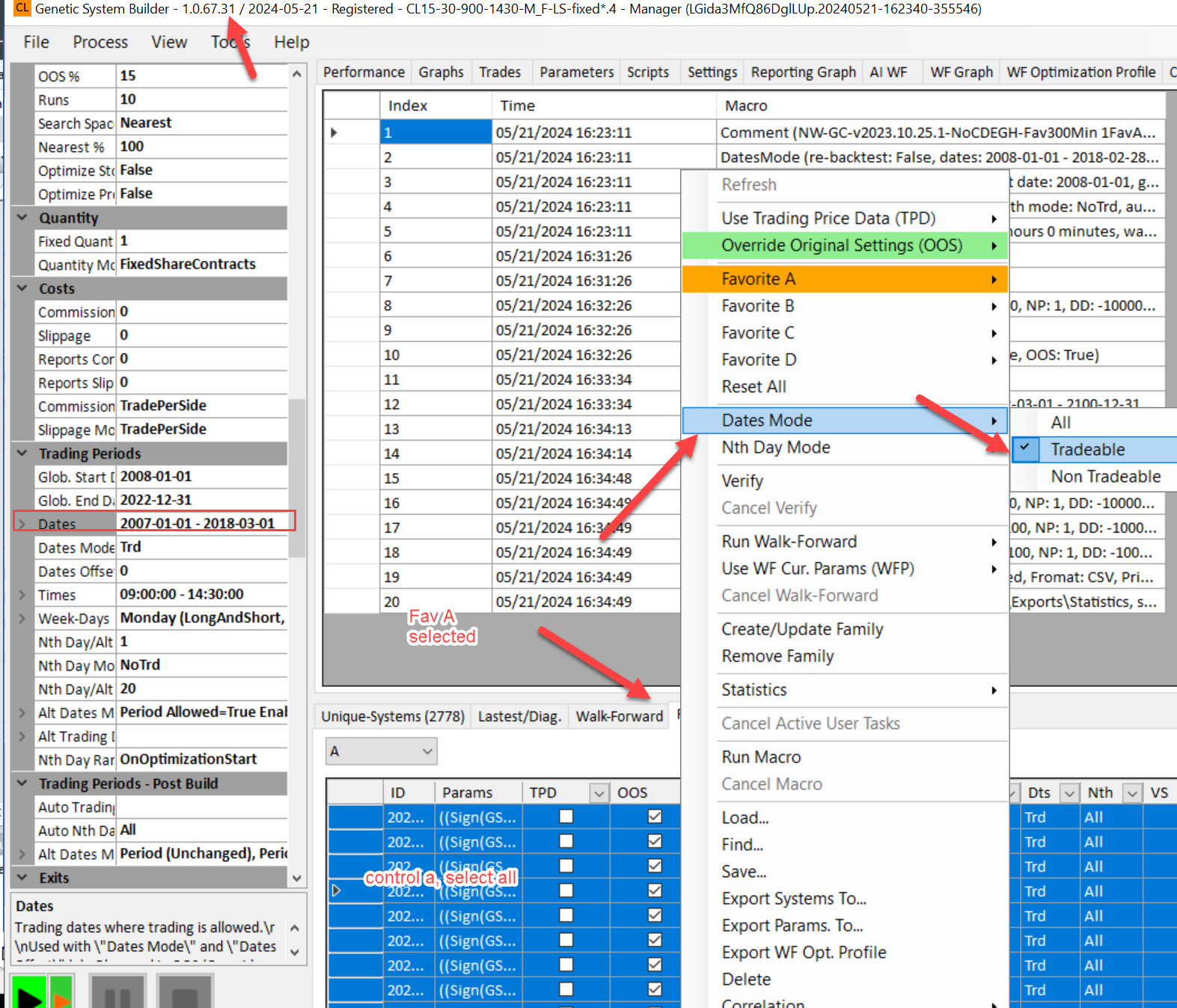
Critical: OOS boundary set before Feb 28, 2018 to avoid mining the day-of-week bias
Focus on your winning day:
• Rebuild systems with Wednesday-only restriction
• Run macro: nct3-300_build_gc_p0.90_pf1.6+stats
• Extends OOS period through March 1, 2022 onward
• Provides fresh data to validate day-of-week edge
• Walk-forward top 250 systems
• Generate statistics using Group1-M3 macro
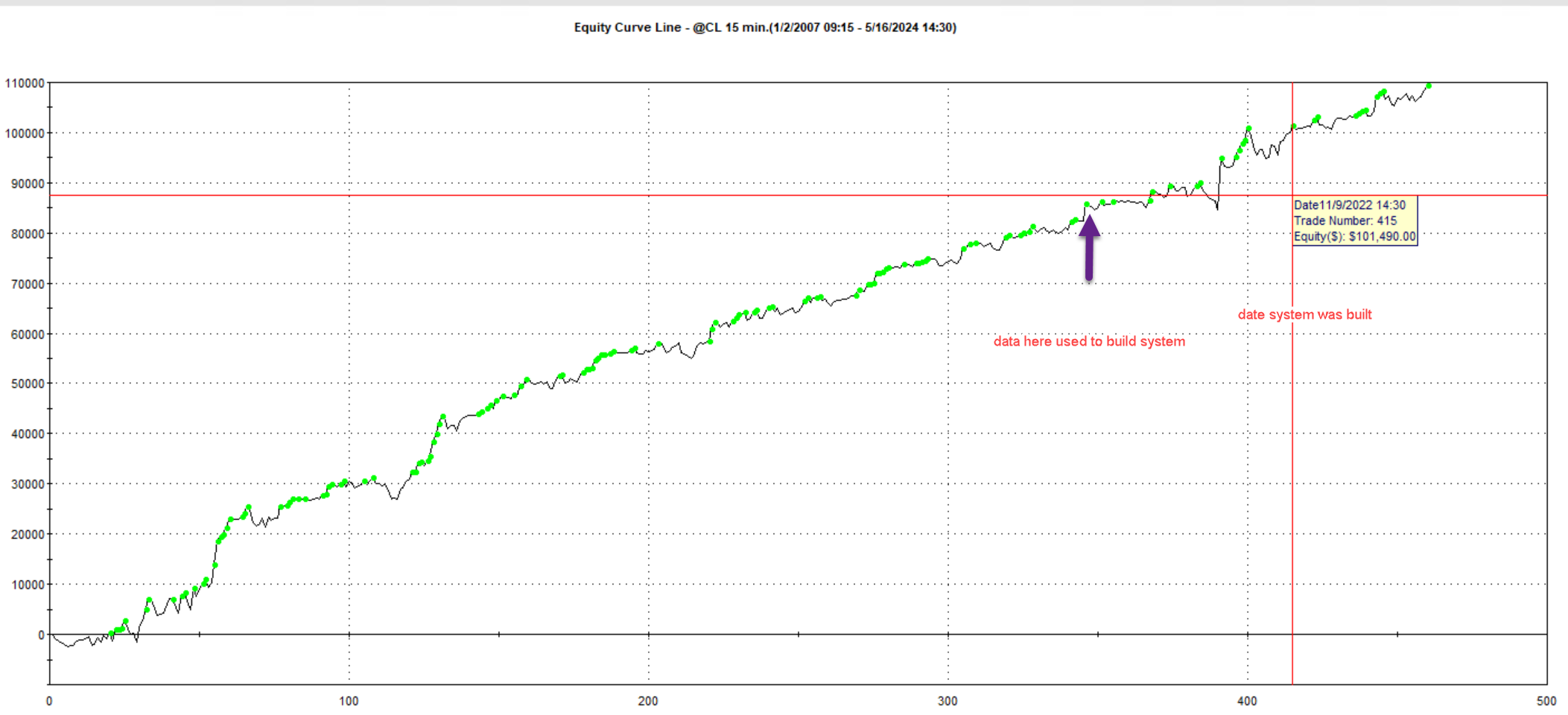
System performance showing consistent profitability through multiple market regimes
Test other day combinations for comparison:
• Use GSB Automation's rotate day-of-week function
• Test all two-day combos (Wed+Mon, Wed+Tue, etc.)
• Compare results across fitness functions
• Note: Monday builds slowly (poor performance)
• Wednesday builds complete quickly (strong results)
• Can also test Wed long/short with other days long-only
This confirms Wednesday's dominance isn't a fluke.
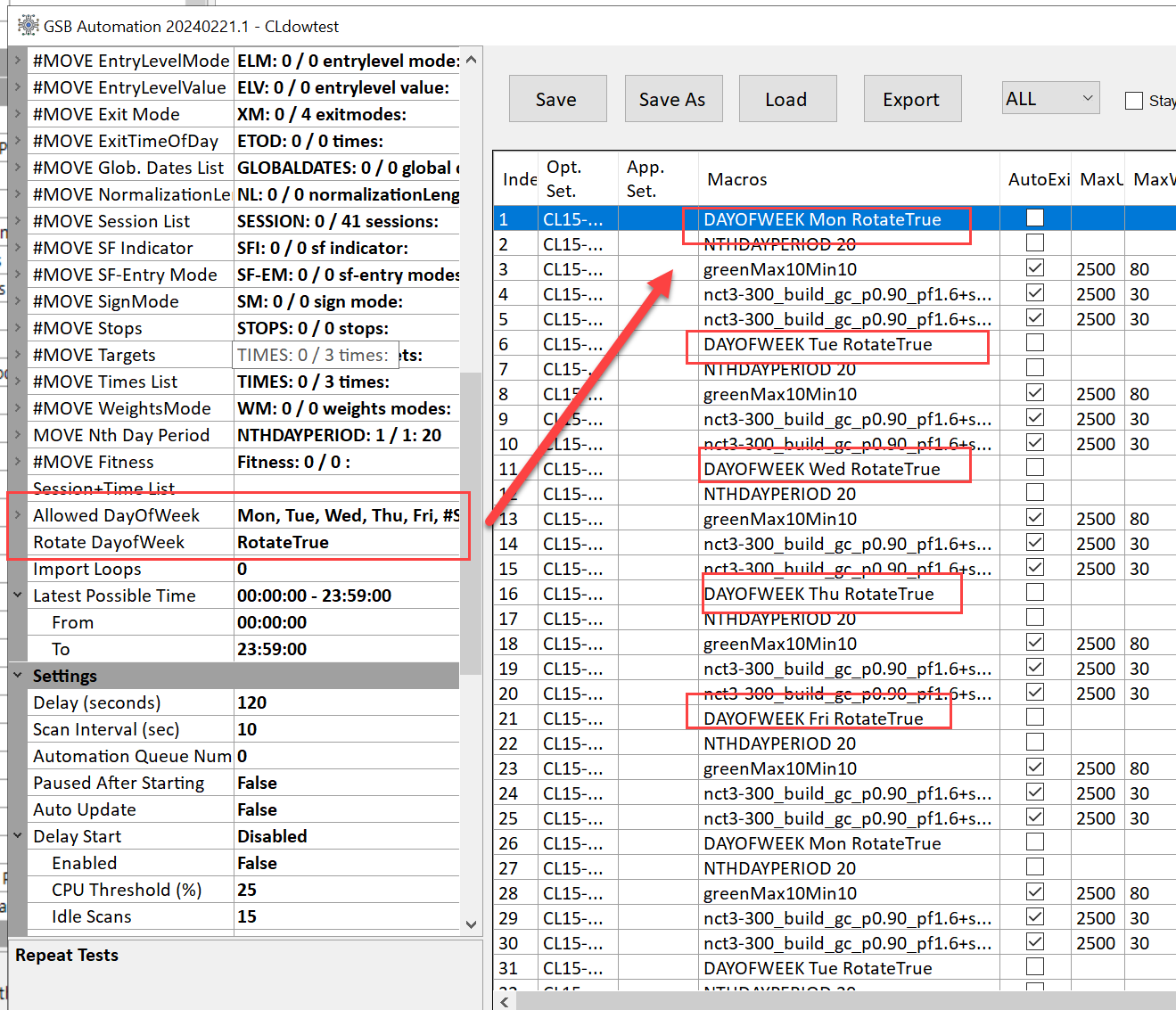
Advanced testing showing all possible two-day combinations to find optimal trading schedule
Results & Insights
Wednesday-only crude oil systems produced outstanding results with much higher Sharpe ratios than full-week systems. The focused approach removes the drag from poor-performing days, particularly Friday which consistently showed losses across multiple test runs. Market conditions post-2018 proved especially favorable—period E (March 2022 onward) sometimes outperformed the in-sample periods, suggesting the weekly cycle edge strengthened rather than degraded. The trade-off: fewer total trades means higher statistical uncertainty per system, making family analysis and multiple system portfolios more important than with daily-trading approaches. Identical tests can show significant variation in which specific indicators get selected, but Wednesday's dominance remains consistent across runs.
Key Takeaways
Day-of-week edges exist in markets driven by recurring news cycles (inventory reports, Fed announcements, etc.)
Trading only the strongest day can outperform five-day systems by avoiding low-probability setups
Sample size matters—aim for 300+ trades when building single-day systems to reduce parameter uncertainty
Validate the day-of-week bias on out-of-sample data BEFORE building day-specific systems to avoid look-ahead bias
Wednesday shows consistent strength in crude oil; your market may have a different optimal day
Expect higher run-to-run variation with smaller datasets—compensate with portfolio diversification
Based on methodology examples from Crude Oil 2024 Day of Week Method documentation, used with permission.